Hello, I am Wang Ma (马旺), a second-year Ph.D student at Rensselaer Polytechnic Institute (RPI) advised by Prof. Qiang Ji. Before coming to RPI, I obtained my B.S. from Southern University of Science and Technology (SUSTech), advised by Prof. Chao Wang.
I have a broad interest in Uncertainty Quantification, Bayesian Deep Learning and their applications to Computer Vision and Natural Language Processing. Recently, my focus is specifically Uncertainty Quantification and Uncertainty Disentanglement for single models and pre-trained models (such as pre-trained large vision or language models), and Knowledge-augmented Bayesian Deep Learning.
News
- Feb 2026: My first-authored paper Towards Knowledge-augmented Bayesian Deep Learning For Computer Vision was accepted to CVPR 2026; My second-authored paper Causal Saliency Map For Post-hoc Model Explanation was accepted to CVPR 2026 Findings!
- Jan 2026: Two papers were submitted to ICML 2026, related to uncertianty decomposition and black-box uncertianty quantification.
- Nov 2025: Two papers were submitted to CVPR 2026, related to Knowledge-augmented Bayesian Deep Learning and causal explanation.
Older News
- Nov 2025: My first-authored paper, Black-Box Uncertainty Quantification for Large Language Models via Ensemble-of-Ensembles, was accepted to the AAAI 2026 AIR-FM Workshop.
- Aug 2025: I completed my summer externship at IBM.
- Mar 2025: I joined IBM as a visiting student researcher working on uncertainty quantification and reasoning with LLMs under Dr. Debarun Bhattacharjya.
- Aug 2024: I started my PhD journey at RPI.
- Jul 2024: I organized a seminar titled "AI: Optimization, Theory & Responsibility" at SUSTech; details at the seminar page.
- Jul 2024: I started my journey as a visiting student in Prof. Chao Wang's group at SUSTech.
- Jun 2024: I graduated from SUSTech.
- Mar 2024: I accepted the offer from RPI and will begin my Ph.D. under Prof. Qiang Ji.
Education Experience
- 2024.08 - 2029.05 (Expected), Rensselaer Polytechnic Institute (RPI)
Ph.D in Computer & System Engineering
Adviser: Prof. Qiang Ji - 2023.03 - 2023.07, University of California, Irvine (UCI)
Academic Study Abroad Program (ASAP) - 2020.08 - 2024.07, Southern University of Science and Technology (SUSTech)
B.S. in Data Science and Big Data Technology
Thesis Adviser: Prof. Chao Wang
Intern Experience
- 2025.05 - 2025.08, IBM Research
Research Extern
Research on Uncertainty Quantification and Reasoning for LLMs
Mentor: Dr. Debarun Bhattacharjya
Publications
-
Towards Knowledge-augmented Bayesian Deep Learning For Computer Vision. CVPR 2026. PDF (coming soon)
Bayesian deep learning (BDL) integrates Bayesian inference with deep learning, improving predictive performance while enabling principled uncertainty quantification. However, existing BDLs often rely on non-informative random priors, limiting the benefits of Bayesian inference. In contrast, knowledge-augmented deep learning explicitly injects domain knowledge during training, yet lacks a probabilistic foundation. In this paper, we propose a knowledge-augmented BDL framework that integrates domain knowledge both as an informative prior and as an adaptive likelihood under a unified two-stage hybrid formulation. In the first stage, we learn a knowledge-informed prior p(θ|K) by pre-training a model to satisfy domain-specific constraints. In the second stage, we perform Bayesian inference on task data with an adaptive knowledge likelihood p(K|θ,D), which dynamically enforces these constraints during optimization. This unified framework enables knowledge to guide both initialization and training, significantly improving prediction accuracy, robustness, adaptation and uncertainty estimation. Experiments on various computer vision tasks, including semi-synthetic and real-knowledge scenarios, demonstrate that our two-stage framework consistently outperforms state-of-the-art Bayesian and knowledge-augmented baselines.
-
Causal Saliency Map For Post-hoc Model Explanation. CVPR 2026 Findings. PDF (coming soon)
Deep learning models often lack interpretability, making it difficult to trust their decisions in critical applications. Saliency maps help explain predictions by highlighting influential input regions, but standard methods mainly capture correlations and local sensitivity, rather than answering the causal “what if we intervene on this region—will the prediction change?” question. To address this, we leverage causal inference to filter out non-causal yet correlated features, ensuring that only regions the model truly relies on are highlighted. Specifically, we propose causal saliency maps, which identify causally relevant features by detecting Causal Markov Blanket (CMB) features using mutual information. To improve efficiency and fairness, we introduce label-wise mutual information for class-specific maps and a window-wise mutual information estimator for fast computation. Our method can be used as a causal refinement on top of standard saliency. On Insertion & Deletion tests and domain generalization benchmarks, it provides more reliable and interpretable explanations.
-
Black-Box Uncertainty Quantification for Large Language Models via Ensemble-of-Ensembles. AAAI 2026 AIR-FM Workshop. PDF (extended version submitted to ICML 2026)
Uncertainty quantification (UQ) is essential for building reliable and trustworthy systems with large language models (LLMs). However, conventional Bayesian or ensemble-based UQ methods are computationally intractable at the scale of modern LLMs and often require white-box access to model parameters or logits. This paper introduces a two-level ensemble framework for black-box uncertainty estimation that operates entirely at inference time and is theoretically grounded in the law of total variance, decomposing total predictive uncertainty into aleatoric and epistemic components. The inner ensemble captures stochasticity and ambiguity through repeated stochastic decoding, while the outer ensemble approximates parameter-driven uncertainty via semantically perturbed prompts that act as proxy samples from an implicit posterior over plausible inputs. By measuring variability in a continuous embedding space, our framework yields interpretable and scalable uncertainty estimates across diverse LLMs. We further provide finite-sample guarantees for our uncertainty estimators, and bound the gap with Bayesian estimators. Experiments on standard benchmarks show that our black-box estimator achieves AUROC comparable to or surpassing state-of-the-art white-box baselines, while providing a meaningful decomposition that distinguishes linguistic ambiguity from knowledge uncertainty.
More
- Baseball I’m a passionate fan of MLB, NPB, and Japan’s National High School Baseball Tournament (Koshien). My favorite NPB team is Hokkaido Nippon-Ham Fighters, where Shohei Ohtani began his professional career in 2013. I’m also a big supporter of Ōmi High School, a rising baseball powerhouse from Shiga Prefecture. You can check out some highlights here — their blue uniforms shine brighter than the August sky.
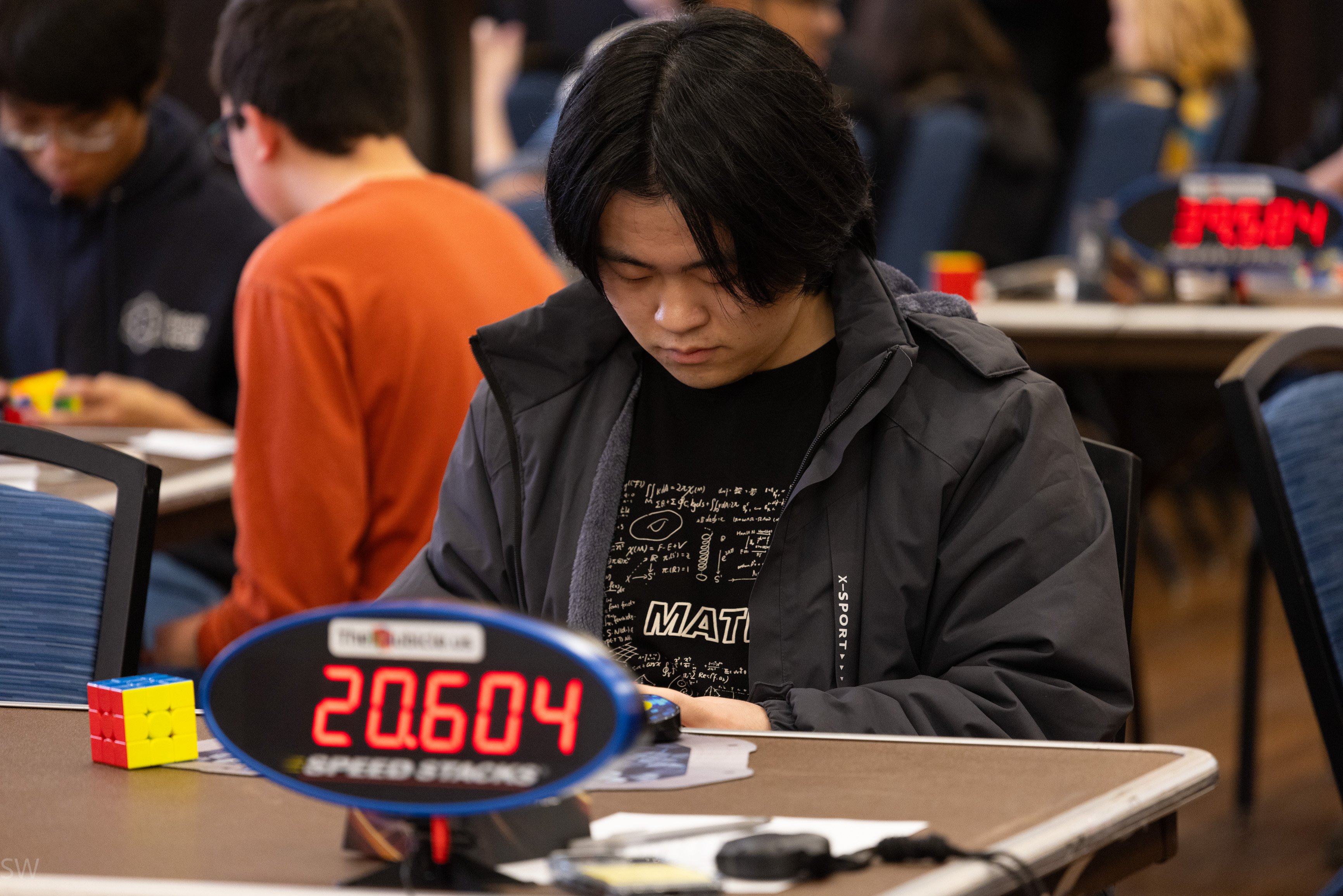
- I am a speedcuber who has participated in over 30 official competitions, with Square-1 being my best event. I am currently ranked No. 3 in mainland China (as of Nov 2025) and earned two bronze medals at the Chinese National Championships in 2017 and 2018. You can find recordings on my Bilibili channel, and official results on my WCA profile. I devoted much of my high school and early university years to Rubik's Cube practice. In May 2021, I achieved my personal best in the Square-1 event and reached No. 2 in mainland China. Through years of pursuing something I truly love, I've learned perseverance — a quality I now bring into my research with the same passion and dedication.
- I’m from Baoji, Shaanxi Province, a region that served as the heart of ancient China for much of its history. I enjoy reading about its rich past, especially the Pre-Qin era and the vibrant Warring States period, known for the flourishing of the Hundred Schools of Thought.